Alexander Neckam on quasi-humans (in re: Seb Falk and James Wade on the “Lost Song of Wade”)
Wade has been solved, or at least has been a bit unmuddled. Who or what is “Wade”? If you don’t know, you’re in good company. Chaucer scholars have been asking themselves the same question ever since reading this stanza from his tragic epic, Troilus and Criseyde, where, about halfway through, a dinner gradually turns into a party:
And after soper gonnen they to rise,
At ese wel, with herte fresshe and glade;
And wel was hym that koude best devyse
To liken hire, or that hire laughen made:
He song; she pleyde; he tolde tale of Wade.
But at the last, as every thing hath ende,
She took hire leve, and nedes wolde wende. (III.610-16)[and after they ate, they rose, and relaxed, with renewed and happy spirits, and they were most admired who could amuse her [Crisyede, presumably] or make her laugh; he sang; she played [an instrument]; he told the tale of Wade [these hes and shes are not anyone in particular; they are members of a crowd]. At last, though, because everything comes to an end, Criseyde said her goodbyes, and had to leave]
The reference in Chaucer’s Merchant’s Tale is both more tantalizing and murkier: “and eek thise olde wydwes, God it woot, / They konne so muchel craft on Wades boot” (and also these old widows, God knows, know so much trickery on [from? about?] Wade’s boat); IV.1422-23. Jill Mann’s Penguin edition renders the line’s sense as “they are so good at telling you tall stories.” Her note though is a record of a scholar hitting a brick wall, echoing the annoyance of the note in the Riverside Chaucer:
Robinson noted that Speght’s comment on this (in his 1 598 ed.) “has often been called the most exasperating note ever written on Chaucer: ‘Concerning Wade and his bote called Guingelot, as also his strange exploits in the same, because the matter is long and fabulous, I passe it over.’ If Speght really knew the story and understood the allusion, he was more fortunate than later editors. For though there are a number of references in medieval literature which indicate he was a famous hero, they do not suffice for the reconstruction of the narrative as it was known to Chaucer.”
Due to the labors of Seb Falk and James Wade, we now have one more reference sorted out.[1] A sermon Falk and Wade ascribe to the English churchman and natural scientist Alexander Neckham (d. 1217) alludes to Wade. As expected for its era, the sermon comes down to us in Latin, but the Wade material is in Middle English, of a quite early variety. It’s hard to parse, likely because the scribe himself didn’t quite know what he was copying. Its first modern editor, Israel Gollancz, did it like so (and I quote Gollancz’s translation): “ Some are elves and some are adders; some are sprites that dwell by waters: there is no man, but Hildebrand only.” Not elves, argue Falk and Wade, but wolves: the line actually reads [in translation]: “Some are wolves and some are adders; some are sea-snakes that dwell by the water. There is no man at all but Hildebrand.”
If the animals faced by Wade’s father, Hildebrand, are common beasts – wolves and adders and sea-snakes – and not elves, Wade’s lost story was not (as many scholars have labored to explain) one of wonders and weirdness, perhaps an evocation of the more eldritch folk beliefs of Old Europe, but rather another straightfoward Chivalric narrative. These do sometimes get a bit weird (Perceforest!), but there’s a limit to that weirdness, and that limit generally stops well short of elves.
My interest is in the sermon itself. Despite the press Falk and Wade have been getting for their work, which largely and understandably focuses on what this means for Chaucer studies, I suspect they too are most interested in what Neckam is doing with his allusion. As they observe, the sermon’s topic, “humility,” is not so much about humility as a virtue as it is about humiliation, “an inevitability” (8), as they observe, what we suffer since Adam and Eve were first punished for their sin in Eden.
The sermon’s theme is 1 Peter 5:6, “‘Humble yourselves under the mighty hand of God, so that he may exalt you in the time of visitation.” There are, the preacher explains, three kinds of humility: that of guilt, that of punishment, and that of penance. He elaborates the first element of this confessional redemptive arc like so:
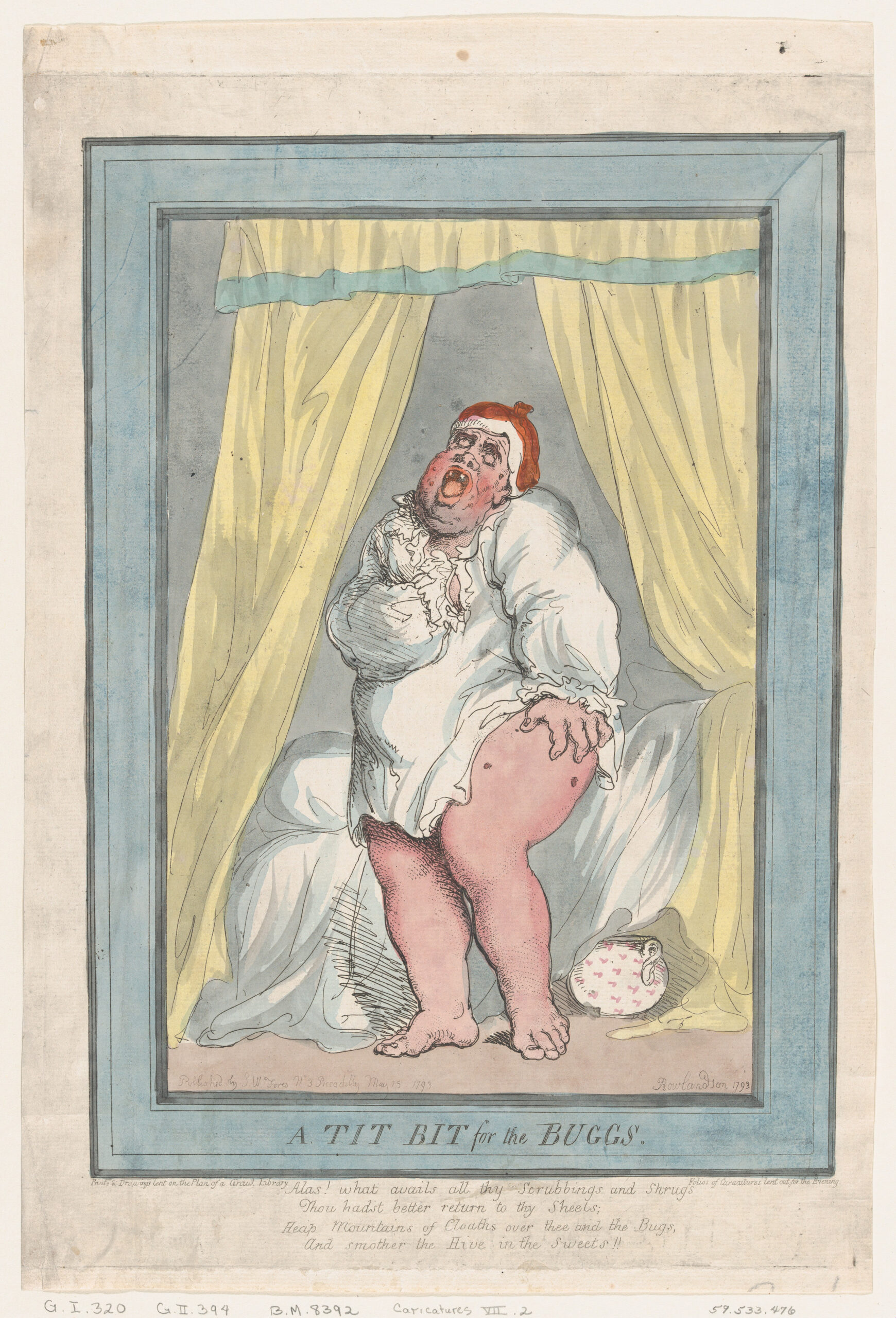
Now, by the humility of guilt our first parent [Adam] was so humbled that, although he was made master of the whole world before his sins and ruled over everything that was in the world, after his sin, on the other hand, he could not even defend himself from a worthless worm, that is, from a flea or louse. He who was similar to God before sin was made dissimilar through sin; since ‘by this poison a rose is sometimes turned into spikenard’ [saliuncam].
Thus Adam was, from a human, made as if he was non-human [Adam itaque de homine factus est quasi non homo]; not only Adam, but almost everyone becomes as if non-humans [nec tantum Adam, sed omnes fere fiunt quasi non homines]. Thus they can say, with Wade [and here it switches to English]: ‘Some are wolves and some are adders; some are sea-snakes that dwell by the water. There is no man at all but Hildebrand’
The preacher then speaks of how different sins make sinners variously bestial. Tyrants are like wolves; the proud like lions; flatterers and backbiters like foxes; gluttons like pigs. Such catalogs are very common in medieval moral discourse, eg, Boethius’s Consolation of Philosophy, where it says that “you cannot regard as a man one who is disfigured by vices”: the greedy are “comparable to a wolf”; the disputatious, dogs; the conniving, foxes; the bellicose, lions; the cowardly, deer; the lazy, donkeys; and so on (4.3.17-21). Twelfth- and thirteenth-century fables, like those ascribed to Marie de France, could easily be made to furnish contemporary examples of lions (who could, of course, be admired too), wolves, foxes, and pigs representing reprehensible human traits.
More interesting, though, is the bit calling Adam and the rest of us “made as if he was non-human.” What has happened here is not a moral fault but rather original sin, a non-volitional fault now inherent to all of us, even the most seemingly innocent babies, which leaves us in this world vulnerable, hungry, cold, and mortal. For this preacher, nothing can cure us of our weakened condition except, of course, Christ. The coming resurrection would give us bodies that would once again be fully human.
In our era, where “to be human” generally means “to admit or show vulnerability” (by crying on camera &c), it should be a bit dizzying to read that being vulnerable somehow diminishes our humanity or otherwise divides us from it.
But, as I have argued for decades now, when medieval writing turned systematically to the question of what makes us human, or otherwise sought to prove our difference from every other form of worldly life, it argued that what evidenced our humanity is our superiority to other animals. We dominate them, and that, in a key bit of circular reasoning, shows that we are better (and that therefore we have reason, are responsible for our actions, that we merit Christ’s sacrifice, that other life is made for our use, &c). As Anselm wrote in his Monologion, “For anyone who doubts that a horse is by its very nature better than wood, and that a human being is more excellent than a horse, should not even be called a human being.”[2]
Except, of course, we do not dominate all animals. Though the largest might harm us, those even we can train (as Augustine observed in his On Free Choice of the Will); but the smallest are an intractable annoyance, or worse. Now, we can imagine that Adam and Eve would have had dominion over the fleas and lice of Eden just as they did (briefly) over every other creature. We can imagine that, first, by melding – as the preacher himself did – the first of the two creation myths in Genesis: for only the first one is ultimately about dominion over animals (Genesis 1:26 – 30), while the second is instead about tending a garden, a rather horizontal relationship with animals, one of which draws us into disobedience, and expulsion. We can imagine this lost dominion, further, by imagining that Paradise had vermin: I haven’t checked what Alexander of Neckam said about fleas and lice in his natural history, but I know there was a long-standing notion that since vermin are generated spontaneously from putrefaction, fleas and lice would have been present only potentially in Paradise’s perfection.[3] All that said, if being fully human requires perfect dominion over the other animals, Adam and Eve should have been as gods even to the fleas, had they been able to meet any.
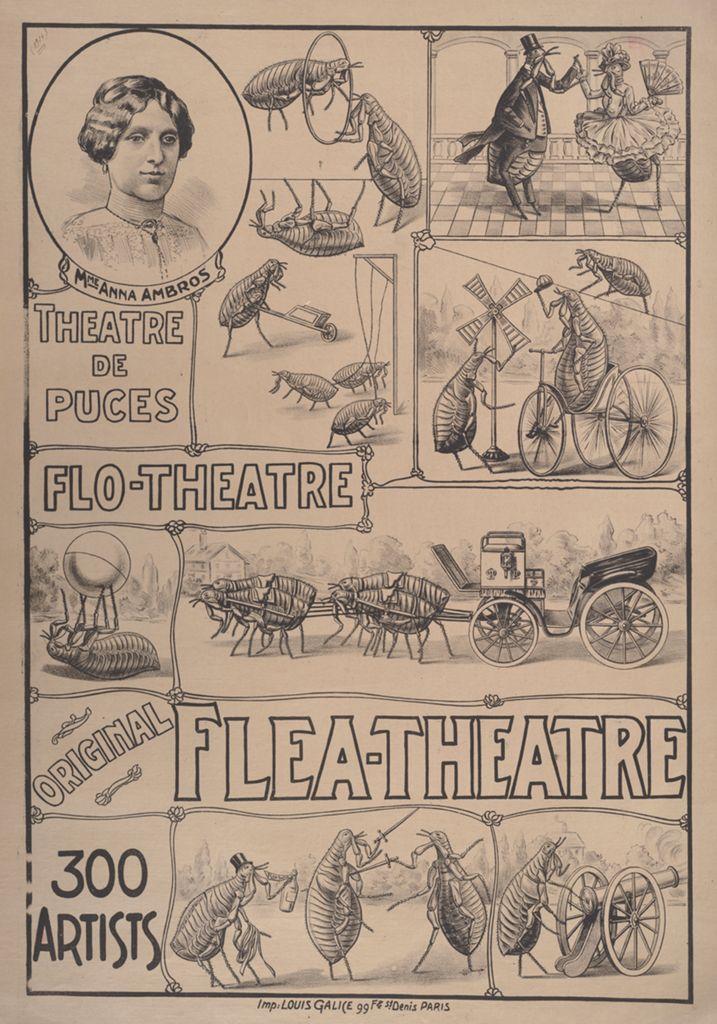
Excepting a few circus impresaria, none of us are their masters, at least not anymore. For that reason, references to vermin offer a handy example, as they do in this sermon, to remind us of our now humiliated condition. We find this in much later, for example, in the fifteenth century, in the “Disputation between the Body and Worms,” where the worm reminds the corpse it’s eating that ever since she came into existence, a host of vermin have been gnawing at her. What she experiences in the grave is no more than an intensification of processes that have been at work on her since birth. So too with Adam.
Because I did my graduate work in the long shadow of poststructuralism and in a program that encouraged, above all, textual exegesis, I have an ineradicable delight in paradox. Bear with me for the last paragraphs.
What all this means is that we are all of us, for now, only quasi-human. To the degree that we fall short of the worldly dominance that should have been our inheritance, we fall short of humanity itself. At the same time, the fact that the gnawing of gnats &c is meant to humiliate us means that we are the object of moral attention from God’s natural creation. Other animals are lousy because we hurt the world; their suffering does them no good. Rather, they suffer for us, to remind us of our fault (as in Honorius Augustodunensis’s Elucidarium).[4] Therefore, at the center of the world’s pain we find the quasi-human, led by their own pain and the pain of others back to their humanity. While our suffering is a sign of our not being fully human, the corrective character of suffering is, at the same time, itself a sign of our being human. In our pain, we don’t quite line up with ourselves, but we are at least being led back to ourselves, and that ongoing failure too is our humanity.
If I were planning to work this up into some kind of article, or if I didn’t have a dissertation to read and other actual writing I’m avoiding, I could push this further by trying to imagine what it means to be human in heaven, when our suffering ends, but with it, our dominion over the other animals. A main line of medieval Christianity denied the afterlife to nonhuman worldly life: no dogs in heaven, no plants in hell, and so forth.[5] Renewed through the resurrection, we would be freed of vulnerability utterly. We would finally be human (again). But we would have arrived at it too late for us to enjoy any of the dominance that Adam and Eve once (briefly) had. In heaven, we would be subjects, members of the celestial court, with bodies capable of almost anything. But we would no more be masters there than we are here, in our fallen condition. The quasi-human becomes the human but too late, really, to enjoy the full fruits of humanity. The first fault of Eden, finally, will never be fully repaired.
- Wade, James, and Seb Falk. “The Lost Song of Wade: Peterhouse 255 Revisited.” The Review of English Studies (2025). ↑
- Thomas Williams trans, p. 4 ↑
- See my chapter on worms in How Not to Make a Human (2019) ↑
- PL 172: 1140B–C, “D. Cum mors et aegritudo sint poenae peccati; cur haec patiuntur pecora, cum per discretionem peccare nesciant? M. Per ea homo punitur, cum eorum dolore vel morte in animo torquetur. D. Hoc potest esse de domesticis; quid dicis de agrestibus? M. Quod ea aegritudine vexantur, evenit eis ex corrupto aere, vel ab aliis rebus, quae ob peccatum hominis in contraria mutantur.”↑
- See my first book for more on this. ↑
