Medieval Nature, Class 1, Genesis
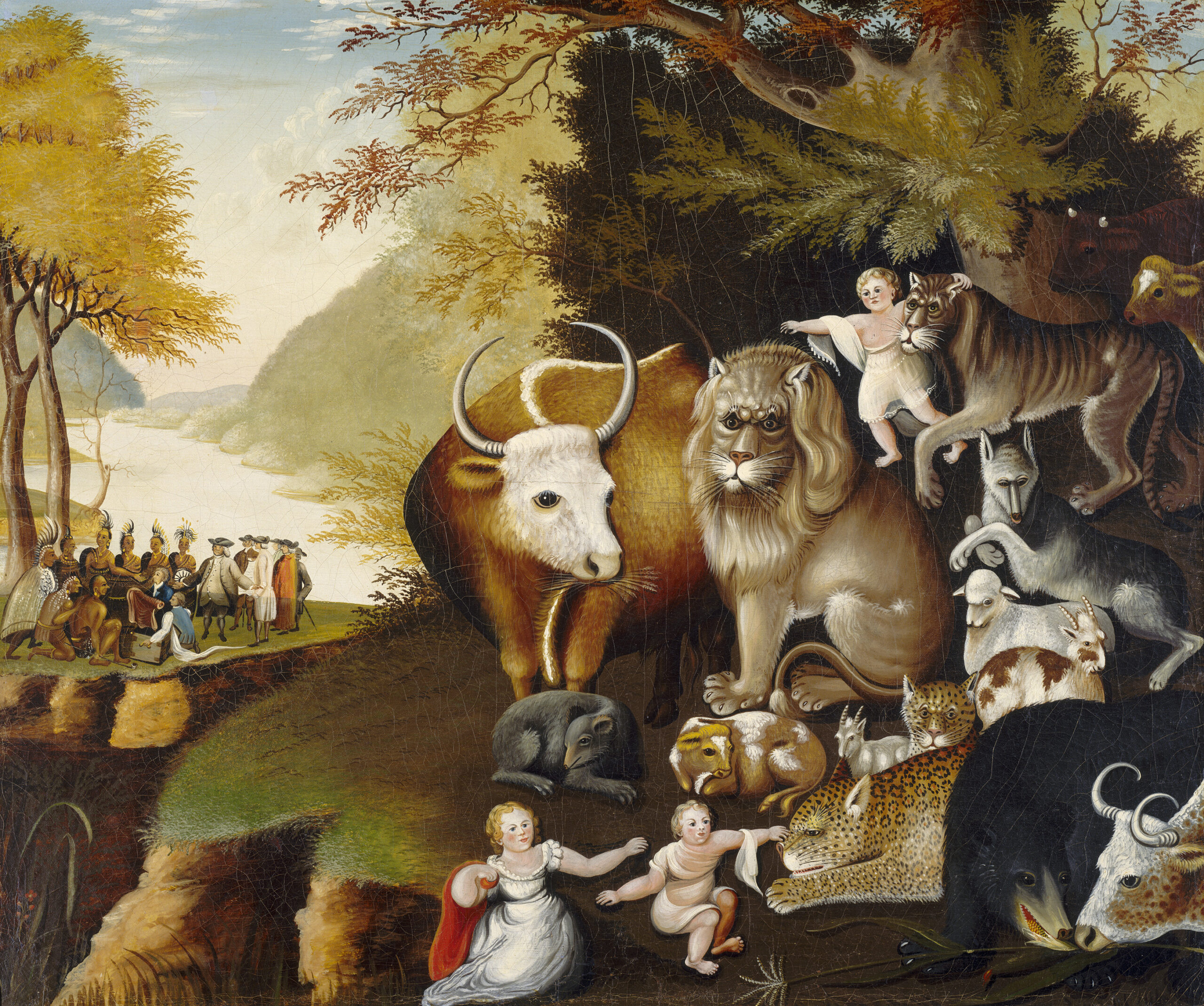
I don’t want to presume that everyone here came in understanding that the first several chapters of Genesis comprise two separate creation stories. The first begins with chaos, then six successive days of creation, concluding with the simultaneous creation of man and woman, who are given dominion over all life, and the plants – crucially, not animals – to eat. The second begins shortly into the next chapter, at Genesis 2:4, “These are the generations of the heaven and the earth, when they were created, in the day that the Lord God made the heaven and the earth,” notably, only a single day.
The day’s first act is to water the earth – not separating water from earth, as in the first story, but combining them – and then forming man, singular and gendered male, from the ensuing slime, and then setting up a paradise. More happens, of course: the animals are soon created, Adam meets them, they don’t quite fit him, and then, from the man, Adam’s, side, woman, and then the temptation, the sudden shock of nudity, and so on. My concern in this little talk is paradise, from Genesis 2:15, “And the Lord God took man, and put him into the paradise of pleasure, to dress it, and to keep it.”
We’re a long ways from Paradise and have been for some time now. Paradise in its modern usage applies to, well, a “place of everlasting happiness, delight, and bliss”: that’s from Wikipedia, as perfect a record of current common wisdom as we could hope to find. We might take issue with the word “everlasting,” surely, since a melancholy relationship to lost paradise is of course key to the concept: that things were once good, before we, and generally we’re the ones to blame, ruined things.
Biblically speaking, though, paradise is not the universal condition of blessedness, lost or otherwise, of the earth unmarred by human error. It is not the earth, as a whole, in that state of primordial balance – a clichéd adjective to which I want you to be very alert this semester – before our hubris injured it. We would do better to locate it not in time but in space.
For Paradise is a local phenomenon. It is a walled space, which is precisely what the word paradise means in its first appearance in Avestan, from ancient Mesopotamia, which survives only as the Zoroastrianism liturgical language. A “Paradise” is an enclosure, a compound of a word for “around” and another for “form or make.” Paradise is not the word in the Hebrew scripture of course: that’s “Eden,” a word that Genesis gives us first in 2:15, which I quoted earlier. “Paradise” passes into the Bible via the Greek Septuagint, whose Pentateuch, the first five books of the Bible, was translated from Hebrew some 2700 years ago, probably in Egypt.
Eden was likely a place, not the garden itself, and here I quote from a recentish article by a the Hungarian scholar Alexandru Mihăilă, “an Aramean state that lay on the Euphrate, between rivers Euphrate and Balikh,” or perhaps, as was traditional even into Christian writing, somewhere in present-day Syria.[1] The garden was not Eden itself; it was located in Eden.
By the time Eden was translated as “Paradise,” Paradise had already come to mean not just an enclosed space of whatever sort but specifically a pleasure garden, the kinds of walled gardens for which the old Mesopotamian potentates were famous. We might better translate the term as “park,” so long as we recall that the notion of a public park is very much a modern idea. A park is a place set aside by elites for their own delights, accessible to those they deem fit to be in it, to share their pleasures, to be awed by its magnificence, or, fundamentally, to those they let in to do the work of keeping it up.
That is, Paradise is not a natural space, a space prior to history and hierarchy, the state in which humans and animals and plants existed as themselves, in their most pure state. If it was in a state of balance, it was a balance whose center of gravity favored, well, the metaphor escapes me at present. It’s a balance, if you will, tipped in favor of someone. Briefly and more sharply: the state before the Fall was already a state. Adam’s fault is not a harm done to Nature itself, but to the park’s master. It was a crime of lèse-majesté.
Adam had been placed in Paradise to tend it. The animals, terrestrial and avian, were made to keep him company, notably, in this story, and unlike the first, out of water and earth, just as he was. Eve was made from him to keep him better company. His job, for he had a job, again, which was to “dress it and keep it.”
The labor of the garden is labor separate from normal labor. Adam is given fruit to eat – Genesis 2:16 — food that trees produce on their own, food that generally requires minimal to no processing to be made edible. We can imagine some of his duties as arboreal. But we can imagine them as aesthetic as well. He is keeping a garden, a paradise of pleasure, separated from the workaday world of having to work with your hands. Adam is both what makes God’s leisure possible – God doesn’t have to work because Adam does it for him – and a sign of God’s majestic leisure, embodied as servants whose work removes him from the indignities of necessary labor. You’ll note that God’s only job here, once he’s made the place, is to supervise, to check in, as it were, on his employees.
When Adam and Eve get fired, the world they now find themselves in does not require aesthetic work of a garden, does not invite the ease of plucking fruit, but rather demands that the earth be worked, in sweat and labor, because they have to, where the indignity is that they now self-employed. These people, made of earth, work until they, dried out, return to the dust. Neither is this space of indignity pure nature either – there is no such space in Genesis 2-3, that’s my key observation. Rather it is a space of a certain immediacy, where the human is at once with and separate from the earth.
Let’s talk about that, and if we can, talk about the bit from Augustine’s Literal Commentary on Genesis quoted in Bede’s Genesis commentary, where Augustine, a powerful person in a slavocracy, can hardly believe that God would have put Adam to work: “Is it really possible that the Lord wanted the first man to work as a farmer? Or is it really credible that he had condemned him to labor before he sinned?” [2]
More, I hope, in conversation.
- Alexandru Mihăilă, “Temple and Paradise, Some Remarks on the Dynamics of Sacred Place,” Review of Ecumenical Studies Sibiu 13 (2021): 145-59 ↑
- Bede, On Genesis, trans. Calvin B. Kendall (Liverpool UP, 2008), 116, Bede quoting from Augustine Literal Commentary 8.8. ↑
