Reason’s Teachings are Donkey’s Work
I’m giving a talk at Brown on September 11th 2025, which happens to be today. Here’s a link to the announcement.
And here’s the talk:
Reason’s Teachings are Donkey’s Work: On the Limits of Humanity in Marguerite Porete’s Mystical Guide to Self-Annihilation
What you’ll hear today is on its way to being the fifth chapter of my third book. My first concerned systematic medieval thinking about human/animal difference; the second nonsystematic thinking about the same topic. The third will be on reason. I’m interested in reason because of a standard definition of what it means to be human, developed in ancient Greece, current through the whole of the Middle Ages, and still alive in many places today, namely, that “man is the rational mortal animal.” We are animal because we are living things; we are mortal because we are living things but not gods; and we are rational because, despite our undivinity, we are still distinct from other mortal animals. The limits and problems of that claim are worth at least a book. Foundational claims for reason in the period I’m studying were as follows: because the rational soul was incorporeal, it was deathless. And because of the rational soul’s incorporeality, we could exercise abstract thought, thereby removing ourselves to some degree from material cause and effect and thus exercising some choice over our actions. That made us morally responsible. Because our soul was undying, we had to live out the consequences of our actions eternally, in heaven or hell.
What I’m offering you today concerns what happens to reason in a work now generally known as The Mirror of Simple Souls. This was a mystical handbook written in the late thirteenth century and perhaps into the first decade of the next. It was first done in Picard French in or near the town of Valenciennes, in what is now Northeast France, at present about 13 kilometers from the Belgian border; at the time, it was a frontier zone, part of the German Empire, and as much an important Dutch city as were Bruges and Ypres.[1] Its original title may have been The Mirror of Simple and Annihilated Souls and Those Who Remain Only in Will and Desire of Love: I say may because virtually none of the work survives in its original language.[2] We now have thirteen manuscripts, in four languages, all of them translations: into Middle French — from which the longer title derives — as well as two translations into Latin, one produced between 1310 and 1317, which in turn produced two separate Italian translations, and another Latin version in England done at the very tail end of the Middle Ages.[3] Nearly all surviving manuscripts were produced on the Italian peninsula.[4] Because the spiritual pronouncements in the Middle English – three manuscripts — are sharper or more outrageous than those of other translations, this version may in fact best represent the original work.[5] The differences between the versions suggest a work that circulated in various stages of production, completion, or attachment to the volition of its author and the author’s editorial vision, but even with what we have. some 43,000 words,[6] we can be certain about its general aims, and why it proved to be such a scandal.
The Mirror, which is what I’m calling it for the rest of my talk, is not a work of mystical ecstasy. There’s no pretense of autobiography, no hint of somatic malaise or excess, no passionate attention to the crucifixion or Christ’s body, and no strong emotions except, perhaps, scorn or arrogance. It lacks any hint of an amanuensis, a patron, or professional advisers who, during its production, might have braked its headlong rush towards spiritual annihilation. That is, if this vernacular work from the Low Countries was the work of a woman — which it very likely was — then it lacks many of the features of other women-authored vernacular mystical works of this region and era.[7] It is singular. To be sure, the Middle English and some of the Latin versions do offer the names of three clerics who offered their approbation of the text, but quite cautiously: one says that he can scarcely understand it, and he is joined by another who warns that the text is “so strong and so cutting” that it should be kept from most or indeed from everyone. And here is what the author herself says about it:
I, a creature made by the maker, by me the maker through himself has made this book. Why that is, I do not know, nor do I want to know. Why? Because I should not wish to know. It is enough for me that it is, through which I might know divine wisdom.[8]
This is a work, then, of a heedless initiate who could not help doing what was done.
In the simplest sense, the Mirror is a work of apophatic mysticism. Because God is infinite, we cannot comprehend God, so the best, indeed the only way, to get close to him is through a process of self-annihilation and a gradual unloosing of the mind from all ways of knowing suitable for mere mortal, bounded things. God’s perfection can require no less. The Mirror gets us there through love, which guides the practitioner through seven stages of increasing refinement of the self, marked by a series of deaths – of sin, nature, and the spirit — giving up the desire to do good, to engage in contemplation and prayer, and to have a will at all, with the goal of disappearing into God. That is, though some readers, both medieval and modern, have misunderstood the Mirror’s abandonment of the virtues as a “heresy of the free spirit,”[9] we have here, quite clearly, a three-stage process of first abandoning the world, then appeals to God, and then the self altogether, of exactly the sort we might find elsewhere, as in, for instance, ibn Tufayl’s twelfth-century Hayy ibn Yaqzan. Insofar as The Mirror can be said to want anything — for one of its goals is to help us realize a kind of existence or non-existence beyond volition — it wants to help us get back to what we always were, our first state, if we can put it this way, of non-creation.[10]
The Mirror describes the practice through an at times contentious dialog between light personifications of three chief figures, Soul, Lady Love, and Reason, along with figures like Holy Church the Little, Holy Church the Great, Courtesy, and the Virtues. On occasion, even God speaks. The core of today’s paper concerns what the Mirror does to and with Reason: briefly, as a teaser, the Mirror calls Reason and reason’s adherents beasts and donkeys. And then Reason dies. I’m sure you can already intimate why that’s so unusual, but I’ll explain at length later. I’d do you a disservice, though, especially if you don’t know the Mirror, if I didn’t spend a little time on its probable author.
I say probable because I am only almost completely certain of its authorship.[11] Since 1946, the Mirror has been ascribed to someone commonly called Marguerite Porete, who probably hailed from the region of Valenciennes, possibly lived for some time as a beguine, and who was, famously, burned to death as a heretic in Paris in 1310. In 1305, the Bishop of Cambrai forbade her from circulating her book and had it burned in Valenciennes. Later, the bishop of Châlons-sur-Marne, some 200 kilometers south, accusing her of recirculating her book, and turned her over to an inquisitor. When she admitted to violating the 1305 stricture to the new Bishop of Cambrai, she was sent on to Paris, where, after more than a year’s confinement, she was killed. Linguistic evidence of the Mirror’s having been written near Valenciennes, where Marguerite was from, and the few surviving trial acts, which describe a heretical book much like the Mirror all at least strongly suggest that the book Marguerite was circulating was the Mirror, and outweigh some explanatory uncertainties, like Marguerite’s book being called “little” by some of her accusers, which the Mirror certainly wasn’t, and the inexplicableness of the book and perhaps Marguerite turning up so far from her native Hainaut before she was taken away to Paris.[12] With all that, we can still be relatively sure that Marguerite may be the only woman in the Middle Ages killed for her writing: relatively, because several parties railroaded her towards execution — her inquisitors, whose investigation were quite irregular,[13] and the French King himself, who had been seeking to assert his supremacy as God’s representative, at least in his own realm, at the expense of the Jews, whom he expelled, the Knights Templar, whom he bankrupted and destroyed, and Marguerite, who died alongside a Jew said to have abandoned his conversion to Christianity.[14] That said, some of the Mirror’s readers clearly thought it perfectly continuous with other works of vernacular mysticism. The late Latin version shares space with a Latin translation of The Cloud of Unknowing, the Middle English with Julian of Norwich’s Revelation of Love.[15] But we also know that the Mirror scandalized and indeed enraged some early readers without their knowing who had written it or even that it had already been twice condemned.[16] Whether that was enough for her to die, though, is almost undecidable. Marguerite herself long refused to cooperate with the investigation, whether to save her life or to live out her convictions, it is unclear.[17] It’s worth remembering that, as with other instances of capital punishment, Marguerite burned not so much because of what she was said to have done but because officialdom wanted her dead, and because her few defenders were so politically feeble.
I have been calling her Marguerite rather than Porete, because Porete — “leeky” or “leek-shaped” we might say — may be only a nickname.[18] Who called her that? If she was a beguine, maybe the other beguines, who may have been of a higher social status than she was. Although some have long held that Marguerite must have been wealthy and well-educated, or perhaps an illegitimate child from a mixed union between nobility and burgess, the French scholar Sylvain Piron has instead argued that she may be that rarest of medieval birds, an authentic intellectual of the lowest classes.[19] If she hailed even in part from the higher statuses, she seems to have been at the very least neglected. The Mirror never quotes from the Psalms, and only very occasionally from scripture, and that almost only as allusions. It never quotes from the Church fathers. The Mirror knows the Roman de la Rose, which was already widely circulating by the 1290s, and William of Saint Thierry’s Golden Letter, and regional trouvère poetry. As for the religious material, whatever else the Mirror knows its author might have picked up from listening to sermons. None of this is what we would expect if Marguerite had more than a rudimentary education in letters. Furthermore, unlike the works of other women mystics of the region and era, Marguerite seems to have been short on patrons and protectors: her three approbators proved no use in preventing her execution, nor did any family come forward to protect her. Neither does her name appear among the women patrons and donors of her region, as we might expect if she had been wealthy and well-connected. Finally, at least for now, a few years ago, Piron’s student Huanan Lu turned up a document from 1323 concerning the beguinage of Saint Elisabeth in Valenciennes, in which the community, during a ceremony to restore their rights, recalled – or we might better say abjured – a long-expelled member who “had disputed on the highest trinity and divine essence,” one they named “Marghoneta.”[20] This diminutive may have been as much as insult as “Porete,” the black sheep of the community, as Piron calls her, who likely produced and distributed the Mirror, and who died for it, for her assault on the reason of the official church, and thus on reason itself during this apogee of Scholastic Philosophy.[21]
Part II
I’ll come back at length to Marguerite and her Mirror later, in my talk’s last section, but getting there requires first explaining what’s at stake in the Mirror’s condemnation of reason. As I have already told you, reason was held to be the capacity that distinguished human from nonhuman animal. Augustine’s City of God is among many works of Latin Christendom that recognize that other animals surpass us physically in many ways: vultures see better, hares are faster, lions stronger, and snakes, as common wisdom ran, live longer. But “we are,” as he explains, better than all these by the possession of reason and understanding.” For everything rested on the claim to reason, not just our superiority to the other animals. Without reason, we have no free choice, and without free choice, we have no moral culpability, and without moral culpability, salvation becomes impossible or unnecessary. What sense could the idea of sin have if humans had no control over their actions?
By the time Marguerite was writing, Aristotle’s scientific works had been present in Christian universities in Latin for nearly a century, helping accelerate and refine new forms of religious disputation and doctrinal proof. These professional disputers, the Scholastics, busied themselves playing out sometimes quite bizarre limit cases in university debates about, for example, questions of whether spirit had something analogous to matter (hence an often misunderstood debate, which concerns only whether multiple angels could occupy the same space simultaneously and not how many angels);[22] whether the food we ate resurrected with our body in the Last Judgment; and whether a person eaten by a wolf, which was eaten in turn by a lion, would be able to resurrect at all.[23] Many of these proofs and debates concerned animal cognition.[24] They joined an intensification of interest in animal behavior throughout the general culture, evident in how natural history proliferates in the public-facing Christianity of the thirteenth century.[25] Though no scholastic work devoted itself exclusively to animal irrationality, the topic itself was very often considered. In sermons, nonhuman animals as a class of beings were the very emblem of damnable attachment to the body and its desires, in short, irrationality, whereas in religious and philosophical work more systematized than sermons and moral commentary – treatises on the soul, commentaries on Peter Lombard’s Sentences, the theological summae that accumulated from the thirteenth century on, and various collections of university disputations – animal irrationality offered itself as an intellectual challenge, a topic diverting enough to merit working through repeatedly.
The key point here is this: in no case was any scholastic willing to recognize any capacity in a nonhuman animal more advanced than quasi-rationality. They knew that dogs and so forth engaged in quite complex activity, often suggestive of abstract thought. They wondered whether sheep that run from wolves, as they always do, are frightened only of those particular wolves, or whether they have some innate conception of lupinity, which enables them to know that wolves as such are a danger even before they meet any in the flesh.[26] Dogs are neutral, even excited, about sticks; but beat a dog with a stick — that’s a medieval example, from Avicenna, not from me — and the dog grows generally frightened of sticks: does the dog now have an abstract sense of universal stickiness?[27] The scholastics always answered these and other such queries by surrounding this clever but bestial behavior with an argumentative wall that confined the irrational animal to no more than merely sensual, embodied thinking.
Consider this thought experiment by Thomas de Bailly, a theologian who died in 1328 in the role of the Chancellor of the University of Paris. Some time earlier, Thomas was also one of 21 clergymen who condemned The Mirror of Simple Souls as heretical,[28] and his recorded university debates date to the period of the book’s condemnation, that is, to the first decade of the 14th century. What Thomas says about reason, then, isn’t just normative — and it is, absolutely — but also particularly normative for understanding the scandal of the Mirror. Thomas writes about a dog that follows a robber to a very remote place and gets the right man. His goal is to demonstrate that the dog found the robber by using only his senses. Per usual, he relies chiefly on existing authorities in natural philosophy. Aristotle, Thomas explains, holds that only humans can think; even elephants, the most tractable and sagacious of wild animals, lack any intellectual capacity. And while humans and animals may both have memory, Avicenna and Averroes – those two great Islamic Aristotelians – each hold that only humans conjoin memory with intellect, which allows them to recall and analyze things long after they have faded from the senses. And so on, with increasingly subtle, yet still familiar, taxonomies of psychological faculties, until Thomas arrives at his conclusion: yes, a dog might catch a thief far from the scene of the crime, but it does this purely through its sensory capacities. The dog might sense the thief’s fear or some other violent passion, or the dog might discover that the thief shares an odor with the air of the place where the theft happened. But nothing other than sensory knowledge enables the dog’s success. It had drawn and can draw no logical conclusions. For, as Thomas explained almost as soon as he started down this familiar path, if a dog were to have a form of thinking that surpassed sensory powers, it would transcend its own species and “esset homo,” and be a human, and, as he observes with almost studious blandness, “quod est inconveniens,” that would be an absurdity.[29]
A long snout, four legs, fur and a wet nose—if dogs could universalize or otherwise think without their bodies, none of this dogginess would stand in the way of their being human. We are what we are not because we are featherless bipeds, but because we alone are the mortal life that conceptualizes. Part of that process of conceptualizing were these very intellectual games of keep away. As Derrida observes in his late work on animals, the list of qualities supposed to be proper to human beings and denied animals “n’est jamais close,” can never be finished.[30] Whenever animals seem to be acting human — by getting their man, for example — the game requires that the definition of what counts as rational activity shifts slightly, with jealous defensiveness, to enclose humans on the inside, and to keep animals out. For the claim to have reason is, as I’ve long argued, is primarily a hierarchical one, rather than a description of a particular kind of thought, and, furthermore, one always necessarily weaponized against both nonhuman animals and most humans.
Part III
Reason is a bulwark. The other animals can never have it, no matter what they do, no matter what they seem to be thinking, because without our exclusive claim to reason, so much falls apart. That’s the idea I want you to keep with you as I move into my next section, where I’m going to raise questions about what reason is, what it wants us to do apart from overmastering animals, and what its limitations are. With all due respect to Thomas Paine, I’m tempted to call the Middle Ages another Age of Reason. Personification — of the soul, the body, the virtues, the vices, wine, anything imaginable — are figures common to medieval writing, personifications of Reason among them.[31] I’ve been surprised to discover that in this tradition Reason tends not to be a figure of free will, or skepticism, or meta-analysis, or independence from tradition, nor even logical induction. As the inheritors or victims of our own “Age of Reason,” all our expectations of what Reason is are bound to be disappointed.
The Reason of Augustine’s Soliloquies is probably the closest we get to familiar ground among these personifications. This early dialog sees Augustine talking to Reason to try to find a way to know God. He offers fascinating material on the truth and falsity of art — an actor’s truth, Reason and Augustine observe, lies precisely in his able feigning — and an insistence that nonhuman animals — his examples here are fleas and bugs — have only animal life, but no life — that is, no rational life — worthy of being loved.[32] Ultimately, what Augustine wants is as certain a knowledge of God as he has of abstract geometric truths, that is, a knowledge independent of the senses, and thus sure, steady, and unchanging, like God. Augustine turns to Reason because Reason’s capacity for immaterial abstraction can free Augustine from sensory limitations.
But reason still has its limitations. Here I can point to, For example, the twelfth-century Anticlaudianus of Alain de Lille. Alain’s work imagines the best possible man, so its presentation of that man’s Reason is therefore as idealized as possible. Even so, Reason suffers from limitations. Reason knows how material things take their particular character from pure Form and its knows the constant motion of Form’s mingling with matter, which is always necessarily a degenerate imitation of Form’s supermaterial ideal. But these are its limits. Reason’s chariot falters as it tries to rise to knowledge of the divine, and nothing but Theology — that’s with a capital T — can take things further. One of the work’s medieval French adaptations adds a scene where, as Reason drives the chariot headlong to flee the vices, her passengers, Prudence and Religion, cry out, “Reason, look out!…You’re going to roll the chariot!”[33] Reason knows things; it’s essential to being human; but reason needs to learn to know its place, as cannot take anyone to the highest truths. Some other, higher vehicle is needed.
On the one side of reason, then, the irrational, on the other, the extrarational. We can complicate this further by dividing reason in two, into scientia and sapiencia, also known as the ratio inferior and the ratio superior,[34] as Augustine did in his De Trinitate: the former a helper, like a woman — that’s Augustine’s metaphor, not mine — for temporal things, and the latter, the superior, contemplative reason, for dealing with eternal things.[35] The Scholastics predictably further refined things. The thirteenth-century Parisian theologian Jean de la Rochelle spoke of the “two faces of reason,” the lower one, concerned with sensible things, and the higher, concerned with sublimities, so sublime in fact that not even the supposedly rational subject can explain them.[36] Later theologians, like Isaac of Stella and Hugh of Pontigny, would subdivide reason still further to save some part of thinking for true immateriality.[37] All these divisions witness to the problem of making reason live up what was demanded of it. If the category of “Reason” functions chiefly to divide humans from animal life, and if animal life is considered to be unfree life, constrained by outside forces, then irrationality could be discovered in any thought that seemed, somehow, inadequately free or celestial, and the charge of “bestial” behavior could be leveled against anyone capable of exercising no more than mere practicality.
Reason itself, that is, stands in the way of ascent to the highest thought, or, to put this another way, thinking could be its own impediment. I am reminded of Max Horkheimer, especially his Eclipse of Reason, lectures he delivered at Columbia University in 1944, as he anticipated both the Nazi defeat and the dangers industrial rationality would continue to pose to free thought and free action in postwar democracies. Without getting into the dialectical history of Reason Horkheimer offers — the death of objective reason, the rise of subjective reason, and the negation of reason itself by the latter — I’m interested in his critique of how “in the view of formalized reason, an activity is reasonable only if it serves another purpose, e.g. health or relaxation, which helps to replenish his working power.” Reasonable action, reasonable thought, is made to have purpose; that purpose is neither thought nor critique, but rather just the preservation and renewal of the subject for socially useful practice. The relevance of this statement for the ongoing starvation of the humanities in higher education worldwide is I’m sure sadly immediate to all of us here.
That socially useful practice is what Marguerite wants to move us beyond. The Mirror takes us beyond the need to do good works, beyond anything that would tie us to a predetermined goal, anything, I should emphasize, that would be recommended for the practical spirituality expected of Beguines. In developing these ideas, Marguerite would also have had in mind other works of spiritual guidance. Notably, even when these works dismiss reason, they don’t do so as utterly as does Marguerite.
Augustine, we have seen, salvages Reason by dividing it into practical and contemplative modes. The fourteenth-century Middle English Cloud of Unknowing, despite its analogous commitment to the abandonment of the self to God’s immensity, nonetheless simply characterizes reason as a particularly human, even ascetic capacity that knows and judges things, which is no way impedes the “work of contemplation” through which it tries to bring the soul close to God. The thirteenth-century Dutch contemplative Hadewijch, more ambiguously, at times makes Reason Love’s guide, while in her ninth vision, Reason is a queen in a dress covered with eyes, who awes her and then serves her until Hadewijch abandons her to serve love and her “unspeakable wonders.”[38]
Elsewhere, Reason is more obviously an impediment, but typically, the problem is understood to be reason’s human limitations. Dante’s Letter to Cangrande, for example, in talking of his Paradiso, speaks of the “intellect in its ascent passing beyond human reason,”[39] and in the Paradiso itself, Dante speaks of Richard of Saint Victor, “as he whose meditation made him more than man.”[40] Richard’s own twelfth-century contemplative manual, his Mystical Ark, speaks of a level of contemplation that “rises above reason,” and one that goes still further “by admitting no human reason,” humanam rationem, “at all.”[41] And the Middle English Book of Privy Counseling, also by the Cloud author, interprets the Biblical Rachel’s death, in giving birth to Benjamin, as demonstrating how “human reason completely dies” “as soon as the soul is touched with true contemplation.”[42] The idea comes from Richard of St Victor. But Richard still divides merely corporeal beasts from a human reason free to think beyond bodies. For Richard, and for spiritual works more generally, human reason may be a problem; but reason, at least, still stands us above animals. It’s still a paradigmatically human capacity.
Part IV
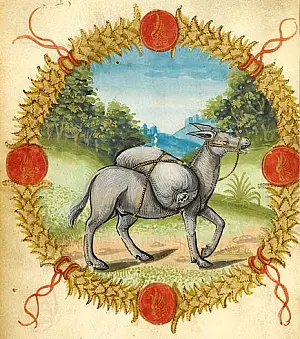
For there, as I told you back at the beginning of the talk, Reason in the Mirror is not human. It is an ass. “Truly,” Marguerite has Love explain to Reason, “the unsophistication and burden of those who are governed by reason surpasses all description. Reason’s teachings are a donkey’s work.”[43] People who follow Reason’s guidelines, says Soul, are “donkeys who seek God in creation.”[44] Those who listen to Reason’s advice “are so bestial and so asinine” that Soul wants nothing to do with them.[45] And late in the treatise, Soul offers to clarify a division of the spiritual practice to make sense for “the bestial understanders.”[46]
Marguerite’s Reason could not be more inept. In her Mirror, Reason’s chief role is to exclaim in dismay as it’s assailed with one paradox after another, occasionally stopping to suggest that Love or its other interlocutors have gone too far. Reason is incredulous, committed to obedience to the virtues — surely as is appropriate for a faculty of moral judgment — and angrily befuddled whenever it’s bullied into abandoning the principle of non-contradiction. Marguerite’s Reason represents her reader prior to receiving the techniques of meditation and prayer she teaches; a perfectly good Christian, but merely rule bound, without much access to grace or God’s infinitude.
Marguerite wants something better than just being reasonable. But it’s not, finally, that she abandons reason; it’s that she perfects its best functions under another name, and thus allows us to understand the purpose of the category of reason without getting hung up on either what we suppose reason does or our own self-regard as rational creatures. Recall that while the category Reason might well describe a particular set of activities — calculation, judgment, analysis, and so on — above all, it describes a particular boundary. That boundary places the so-called rational actor on the side of freedom: freedom from the body, freedom from stolid animality, and freedom from those humans who, because of their unfreedom, might as well be animals. That division is one Marguerite doesn’t abandon; instead, she doubles down on it.
For in teaching her readers to be better Christians, Marguerite is also teaching them to realize their full humanity, and does this — in the paradox characteristic of such spiritual guidebooks — by demanding that her readers recognize their rational humanity as actually bestial. Marguerite wants her readers to abandon Reason by entering into a superrational realm where the dull boundaries of created Being no longer apply. But as she does so, she also preserves the characteristic structural division between Reason and Irrationality, but, in this case, by demoting what she calls “Reason” to the side of bestial irrationality. The perfected, annihilated soul is better than merely human, because the mere human is now understood as bestial. Submissive to the virtues, Bestial Reason is rule-bound, without freedom. Attentive to the created world, including its own self — for the human rational soul is a created thing – it is bound to this world so long as it refuses to allow itself to move past itself towards the infinite. By reading only for the literal sense, Reason is a sheep of “bestial..understanding,” who takes “the chaff and leave the grain”:[47] this medieval metaphor of bad exegesis could hardly be more widespread, and here means that Reason can understand no more than what is right before it. Reason is like an animal, or an uneducated layperson, or indeed like a Jew, whom Christians often accused of reading materially, like livestock, in exactly these terms.
It’s notable, then, that Marguerite is so elitist. In language drawn from aristocratic culture and its narratives, she characterizes merchants as “thralls,” servants or slaves, because they “meddle in merchandise,” and she imagines Reason as like a churl who shows up at a gentleman’s court, without the lineage that would justify his presence.[48] She draws an analogy about how no gentleman would ever deign to respond to a peasant’s demand to do honorable battle. She characterizes Reason as being rude, as being, in other words, low-class, like the kind of people who also have no regard for higher things. That she does this is no indication of her class background: she could well be a striver, and even if she weren’t, she certainly knows the rules of the social game well enough to make use of them.
I cannot help but read the Mirror alongside an anti-peasant polemical poem surviving in a single late thirteenth-century manuscript mostly filled with fabliaux: this is “Le Despit au vilain.” The Despit recommends that peasants should “live in the woods and be enclosed in a sty,” be forbidden to eat beef, and “eat thistles, / brambles, thorns, and straw”. Peasants should “pasture on grass with the horned cows on all fours, entirely naked.”[49] The literature of social complaint often lamented that lords metaphorically engaged in anthropophagy, living off the bodies of their peasant workforce.[50] Here’s a case where that literature of complaint is turned around, for if peasants are really livestock, one imagines that only a modicum of decency kept the poem from modestly suggesting that the lord sometimes make of them a meal.
What all peasants and animals have in common are their unfreedom. Reason’s adherence to sensible facts, to careful syllogistic chains, to the existing knowledge of what she calls the “Holy Church the Lesser” — recall, for example, Thomas de Bailly’s reliance on Aristotle, Avincenna, and other authorities — makes it similarly unfree. So, when Marguerite characterizes Reason as animalized and servile, however much she may have abandoned the name of Reason, she has, by no means, abandoned its function or self-delusions. Her characterization of reason as bestial is of course part and parcel of her frequent recourse to paradox, a standard feature of such mysticism: the soul that has nothing possesses everything, we become united to God by abandoning the virtues, and reason is actually animal, so much so that for Marguerite to say “human reason” and “bestial reason” is to say the same thing.[51] But all this paradox is oriented at something grander than conceptual slippage. It is aimed at freedom, the grandest freedom of all, because divine, and because divine, beyond human conceptualization. Under cover of paradox, she has smuggled in the ideological function of Reason, because she preserves the distinctions that typically travel under the titles of Reason and Irrationality. She offers a small elite freedom, and correspondingly denies it to everyone else.
The implications of her animalization of what she calls Reason are equally typical: those on the wrong side of the boundary might be able to read, or to put things together logically, but they’re unable to think; what they think of as thinking is only mechanical, without true understanding; what they mistake as thinking is actually only obedience; and, at best, they are made to serve. In sum, it little matters that Marguerite scorns what she calls Reason as “bestial understanding,” as she’s preserved Reason’s hierarchies, prejudices, and self regard when she presents herself, and her practice, as the only proper activity for truly liberated, free-thinking people. Or, to put this another way, for the only people.
At last, of course we have to admire Marguerite for what she did with the Mirror. Holy Church the Lesser for her stood for reason, for credentialed academic logical theology, and perhaps even for men or, more broadly, male-identified religion; her Church aimed to undermine that, offering a direct route to the infinite accessible only to those willing to give up the sacrifices we all have to be make to be social subjects, which is to say, subjects. That she advanced her program through paradox and logical contradiction, some of them drawn from secular love literature, suggests a post-rational “blurring of boundaries.” But we must recognize that no boundary works perfectly – that’s a poststructuralist truism. Marguerite blurred boundaries to be sure, among them, those between high and low, existence and non-existence, the need to explain and the imperative to transcend explanation, but she builds another at the same time, that between the free and the unfree.
With her, as elsewhere, I’m finally wary of how claims for freedom or liberation rely upon a disdained foundation of supposedly abandoned unfreedom. Whatever’s left behind in the position of unfreedom will be subject to the disdain the now, supposedly free subject claims for themselves. So long as the free subject believes itself to surpass any given categories — and what better illustration of that than the annihilated subject of Marguerite’s Mirror — then it can ignore its own constraints, its own necessary unfreedoms. My goal, then, isn’t to liberate us from bestial reason, nor am I interesting in accusing Marguerite of not going far enough: as a theological woman, she may have keenly felt the masculine constraint of what passed for “institutional reason.”[52] Rather, more simply, my aim has been to make us more attentive to the kind of delusions that travel under the paired claims of reason and freedom from reason’s constraints.
Thank you.
- This point is stressed at the opening of John H. Van Engen, “Marguerite of Hainaut and the Low Countries,” in Marguerite Porete et le Miroir des simples âmes : perspectives historiques, philosophiques et littéraires, ed. Sean Field et al. (Vrin, 2013). ↑
- The closest we have are fragments in Picard, excerpted from a version likely close to the original, Valenciennes Bibliothèque municipale MS 239. ↑
- The errors in the Middle French suggest a now lost Latin intermediary between the Old and Middle French: Sylvain Piron, “Marguerite, entre les béguines et les maîtres,” in Marguerite Porete et le Miroir des simples âmes : perspectives historiques, philosophiques et littéraires, ed. Sean Field et al. (Vrin, 2013), 85. The date for the first Latin translation derives from research by Piron, tightened by work in Justine L. Trombley, A Diabolical Voice: Heresy and the Reception of the Latin Mirror of Simple Souls in Late Medieval Europe (Cornell University Press, 2023). The second Italian version may have had a French Mirror handy as well: Michael G. Sargent, “Medieval and Modern Readership of Marguerite Porete’s Mirouer Des Simples Âmes Anienties: The Manuscripts of the Continental Latin and Italian Tradition,” in The Medieval Translator. Traduire Au Moyen Age: In Principio Fuit Interpres, ed. Alessandra Petrina (Brepols, 2013), 92. ↑
- The number of manuscripts is 17 if we include incomplete copies, which range from fragments to a Latin copy that is roughly sixty percent complete. Material discussed in Trombley, A Diabolical Voice suggests that the number of circulating copies may have been much higher (e.g., 36 reputed to have been burned in Basel), or that it was at least thought useful to promote the the Mirror as “a sort of heresy super-spreader.” ↑
- Robert E. Lerner, “New Light on The Mirror of Simple Souls,” Speculum 85, no. 1 (2010): 91–116. ↑
- It is printed with 139-40 chapters, from divisions present only in the Middle French. An early Latin version may have been divided into chapters too, although fewer than the Middle French: Trombley, A Diabolical Voice. ↑
- See especially Amy Hollywood, “Suffering Transformed: Marguerite Porete, Meister Eckhart, and the Problem of Women’s Spirituality,” in Meister Eckhart and the Beguine Mystics: Hadewijch of Brabant, Mechthild of Magdeburg, and Marguerite Porete, ed. Bernard McGinn (Continuum, 1994). More briefly, Sean L. Field, The Beguine, the Angel, and the Inquisitor (University of Notre Dame Press, 2012), 203. ↑
- Marguerite Porete, Speculum Simplicium Animarum, ed. Paul Verdeyen and Romana Guarnieri, CCCM 69 (Brepols, 1986), 404, “I, creature ymaad of þe maker, bi me þe maker haþ maad of him þis booke. Whi it is, I not, ne I kepe not wite. Forwhi? I owe it not; it suffiseþ me þat it is, wherynne I may knowe þe diuine wisdom.” “Ego creatura a creante condita, mediante qua Creator de se fecit hunc librum, pro quibus nescio nec scire uolo, quia hoc no debeo velle. Sufficit enim mihi si est in secreto scire diuinae saptientiae et in spe.” This passage, along with the assessment of the three approbations, does not appear (or survive) in the Middle French translation. Verdeyen’s edition of the Latin requires updating with Latin manuscripts that have turned up in the last several decades. For a brief statement on what a good edition requires, Sargent, “Mirror Readership,” 93. ↑
- Marguerite was certainly no adherent of this heresy. The larger question is whether anyone at all was or whether it was just a moral panic, which, like so many others, was dangerous to the innocent, and prone to encouraging precariously adjusted people to act out. The foundational study: Robert E. Lerner, The Heresy of the Free Spirit in the Later Middle Ages (University of Notre Dame Press, 1972). ↑
- Here I am indebted to Joanne Maguire Robinson, “Marguerite’s Mystical Annihilation,” in A Companion to Marguerite Porete and the Mirror of Simple Souls, ed. Wendy R. Terry and Robert Stauffer (Brill, 2017) and Bernard McGinn, “Annihilated Women in the Thirteenth Century,” in Mystical Women in the West: Growing in the Height of Love, ed. John Arblaster and Rob Faesen (Routledge, 2024). Summaries of the Mirror abound in the scholarship, none quite the same, as all that can be done is to read it, while hazarding the quite variable quality of existing editions and translations. ↑
- Doubts about authorship raised in Elizabeth A. R. Brown, “Jean Gerson, Marguerite Porete and Romana Guarnieri. The Evidence Reconsidered,” Revue d’Histoire Ecclésiastique 108, nos. 3–4 (2013): 693–734; Elizabeth A. R. Brown, “Marguerite Porete, John Baconthorpe, and the Chroniclers of Saint-Denis,” Mediaeval Studies 75 (2013): 307–44 were answered in Sean L. Field et al., “A Return to the Evidence for Marguerite Porete’s Authorship of the Mirror of Simple Souls,” Journal of Medieval History 43, no. 2 (2017): 153–73. That said, Brown’s essays were clarifying in demanding increased precision in terms and use of evidence, and sharply distinguished second-hand from primary witnesses. ↑
- Her book was also accused of certain heretical statements about the Eucharist, none of which appear in any surviving version of the Mirror. ↑
- Henry Ansgar Kelly, “Inquisitorial Deviations and Cover-Ups: The Prosecutions of Margaret Porete and Guiard of Cressonessart, 1308–1310,” Speculum 89, no. 4 (2014): 936–73. ↑
- Field, Beguine. ↑
- Wolfgang Riehle, The Secret Within: Hermits, Recluses, and Spiritual Outsiders in Medieval England, trans. Charity Scott-Stokes (Cornell University Press, 2014), 135. ↑
- Trombley, A Diabolical Voice. ↑
- Zan Kocher, Allegories of Love in Marguerite Porete’s “Mirror of Simple Souls” (Brepols, 2009) proposes the second of these options. ↑
- Here I am following Lerner, “New Light,” 92–93, who says that the no such surname has been found in Hainaut; Van Engen, “Marguerite of Hainaut,” 30, cites Kocher, Allegories of Love, 24–26, who says the contrary. “Porete” does appear three times in the trial documents, which once refer to her as “Margarete Porete” and twice as “M. Porete”: Van Engen, “Marguerite of Hainaut,” 30 n15, citing transcriptions in Field, Beguine, 209–31. ↑
- Piron, “Marguerite, entre les béguines et les maîtres”; Sylvain Piron, “« Une dénommée Margonette ». Hypothèses sur les origines sociales de Marguerite Porete,” Médiévales. Langues, Textes, Histoire, no. 85 (2023): 99–115. ↑
- Huanan Lu, “Marguerite Porete et l’enquête de 1323 sur le béguinage Sainte-Élisabeth de Valenciennes,” Revue du Nord 440, no. 3 (2021): 451–85. The Mirror’s attack on beguines, along with the four mendicant orders, in its final poem does suggest an author who may have once been a beguine and who was no longer. ↑
- Piron, “Marguerite, entre les béguines et les maîtres,” 80, “Écrit par une femme, en language vernaculaire, sur un mode narrative et poétique et maniant une autre logique fondée sur le paradoxe and la réverisbilité des contraires, le Miroir est à tous points de vue aux antipodes des canons de la théologie universitaire.” ↑
- For example, Henry of Ghent et al., Les anges et le lieu: quatre questions sur la localisation des substances séparées, trans. Tiziana Suarez-Nani et al. (J. Vrin, 2017), 188–89, Richard of Middleton’s question on “Utrum plures angeli possint simul esse in eodem loco,” from his Sentences commentary. ↑
- Philip Lyndon Reynolds, Food and the Body: Some Peculiar Questions in High Medieval Theology (Brill, 1999). ↑
- Anselm Oelze, Animal Rationality: Later Medieval Theories 1250-1350 (Brill, 2018); Ian P. Wei, Thinking about Animals in Thirteenth-Century Paris: Theologians on the Boundary Between Humans and Animals (Cambridge University Press, 2020); Juhana Toivanen, “Marking the Boundaries: Animals in Medieval Latin Philosophy,” in Animals: A History, ed. Peter Adamson and G. Fay Edwards (Oxford University Press, 2018); Juhana Toivanen, “Pierre de Jean Olivi, les animaux et le jugement rationnel ou non rationnel,” Revue des sciences philosophiques et théologiques 106, no. 3 (2022): 443–64. ↑
- Nigel Harris, The Thirteenth-Century Animal Turn: Medieval and Twenty-First-Century Perspectives (Springer International Publishing, 2020). ↑
- For examples of the sheep and wolves thought experiment, see Avicenna’s Liber de anima (Oelze, Animal Rationality, 34–35), the thirteenth-century De anima of John Blund Peter G. Sobol, “The Shadow of Reason: Explanations of Intelligent Animal Behavior in the Thirteenth Century,” in The Medieval World of Nature: A Book of Essays, ed. Joyce E. Salisbury (Garland, 1993), 113–14), and Albert the Great Jörg Alejandro Tellkamp, “Aping Logic? Albert the Great on Animal Mind and Action,” in Subjectivity and Selfhood in Medieval and Early Modern Philosophy, ed. Jari Kaukua and Tomas Ekenberg (Spring, 2016)). ↑
- Avivenna and Averroes in Oelze, Animal Rationality, 63–66. ↑
- Troy J. Tice, “‘Containing Heresy and Errors’: Thomas of Bailly and the Condemned Extracts of the Mirror of Simple Souls,” The Catholic Historical Review 104, no. 4 (2019): 614–35. ↑
- Thomas de Bailly, Quodlibets, ed. Palémon Glorieux (J. Vrin, 1960), 258–60. ↑
- Jacques Derrida, L’animal que donc je suis (Galilée, 2006), 19; Jacques Derrida, The Animal That Therefore I Am, ed. Marie-Louise Mallet, trans. David Wills (Fordham University Press, 2008), 5. ↑
- For a treatment of reason in contemplative works over a longer period, emphasizing not the divisions but the interrelations, between reason and contemplation, Christina Van Dyke, A Hidden Wisdom: Medieval Contemplatives on Self-Knowledge, Reason, Love, Persons, and Immortality (Oxford University Press, 2022), 68–92. ↑
- Augustine, The Happy Life; Answer to Skeptics; Divine Providence and the Problem of Evil; Soliloquies, with Denis J. Kavanagh et al., Fathers of the Church 5 (Cima Publishing Co., 1948), 11. ↑
- Andrew J. Creighton, ed., Anticlaudien: A Thirteenth-Century French Adaptation of the Anticlaudianus of Alain de Lille, by Ellebaut (Catholic University of America Press, 1944), “Raison, prenez garde … Vus et le char verrez tumer,” ll. 2945-2947. ↑
- Marie-Dominique Chenu, “Ratio superior et inferior : un cas de philosophie chrétienne,” Revue des Sciences philosophiques et théologiques 29, no. 1 (1940): 84–89. Robert W. Mulligan, “Ratio Superior and Ratio Inferior: The Historical Background,” The New Scholasticism 29, no. 1 (1955): 1–32. ↑
- Saint Augustine, The Trinity, trans. Stephen McKenna (Catholic University of America Press, 1963), 343–45. ↑
- Jean de la Rochelle, Summa de Anima, ed. Jacques Guy Bougerol (J. Vrin, 1995), 146–47. ↑
- Bernard McGinn, The Golden Chain: A Study in the Theological Anthropology of Isaac of Stella (Cistercian Publications, 1972); Nicholas Thomas Groves, “The Sermons of Hugh of Pontigny: A Critical Edition and Introduction” (Ph.D., The University of Chicago, 1983), 128–29. ↑
- Hadewijch, The Complete Works, trans. Columba Hart (Paulist Press, 1980), 285–86. ↑
- Dante Alighieri, Epistolae, trans. Paget Jackson Toynbee (Clarendon Press, 1920), 190, 208–9. ↑
- Dante Alighieri, Paradiso, trans. Allen Mandelbaum (University of California Press, 1982),“che a considerar fu più che viro,” X.132. ↑
- Jacques Paul Migne, ed., Patrilogiae Cursus Completus: Series Latina, 217 vols. (Paris, 1844), Benjamin Major, also known as The Mystical Ark, 196: 74b; Richard of St Victor, The Twelve Patriarchs ; The Mystical Ark ; Book Three of The Trinity, trans. Grover A. Zinn (Paulist Press, 1979), 167. ↑
- Phyllis Hodgson, ed., The Cloud of Unknowing and The Book of Privy Counselling, EETS 218 (Oxford University Press, 1944), 150, “as sone as a soule is touched wiþ verrey contemplacion, as it is in þis noble nou3tyng of it-self & þis hi3e allyng of God, sekerly & verrely þan di3eþ alle mans reson,” translation from A. C. Spearing’s for Penguin. ↑
- Marilyn Doiron, “Margaret Porete: The Mirror of Simple Souls, a Middle English Translation,” Archivio Italiano per La Storia Della Pietà 5 (1968): 317, “Soþeli, seiþ sche, þei þat ben guerned by reson, þe rudenesse ne þe combringes of hem no man may seie. At her techinges it schewiþ an asse deede.” The Middle English differs from surviving Latin and French versions: Porete, Mirror, ed. Verdeyen and Guarnieri, 240–41, “vere, dicit ipsa Anima, nec ruditatem,nec impedimentum ipsius rationis nullus dicere posset. In suis discipulis apparet ; unusu asinus nichil faceret, qui uellet audire”; “nul ne pourroit dire ne penser la rudesse ne l’encombrier de Raison : a ses disciples assez il appert, ung asne n’y feroit oeuvre, qui les vouldroit oïr.” Marguerite Porete, The Mirror of Simple Souls, trans. Edmund Colledge et al., with Kent Emery (University of Notre Dame Press, 2010), 109, “no-one could tell or conceive how crude and burdensome is REason, but it is plainly seen from Reason’s disciples that an ass would achieve nothing which was willing to give them ear.” Note that Meister Eckhart “distinguishes between those who understand such true poverty and the ‘donkeys’ who believe that poverty lies in the works of the active and contemplative lives” (qtd in Hollywood, “Suffering Transformed,” 102–3. While this may superficially sound like the Mirror, note that that Eckart says this not about reason, but about different forms of human activity. ↑
- Doiron, “Middle English Mirror,” 306, “Suche folkis, seiþ þis soule, þat I clepe asses, seken God in creatures and bi hilles and dales.” Porete, Mirror, ed. Verdeyen and Guarnieri, 194–97, “Telz gens, dit ceste Ame, que je appellee asnes, quierent Dieu es creatures, es monstiers par aourer, en paradis creez, en paroles d’ommes, et es scriptures”; “Tales, dicit haec Anima, quos asino uoco, quaerunt Deum in creaturis, in templis orando,in paradiso create, in uerbis hominum et in scripturis.” Porete, Mirror, trans. Colledge, Marler, et al., 90. ↑
- Doiron, “Middle English Mirror,” 304, “To alle þo, seiþ sche, þat lieun by 3oure counseil, þat ben s bestial & so assed þat me bihoueþ for her rudenesse answere my langage.” Porete, Mirror, ed. Verdeyen and Guarnieri, 192–93, “Omnibus, dicit Ipsa, qui de uestro consilio uiuunt, qui sunt ia bestiales et asini, quod oportet me propter eorum ruditatem variare, immo ascondere proprium meum linguagium, ne mortem accipient in esse vitae, in qua sum in pace nichil mendicans penitus”; “A tous ceulx, dit elle, qui de vostre conseil vivent, qui sont si bestes et si asnes que il m’esconvient pour la rudesse d’eulx celer et non parler mon langage, ad ce qu’ilz ne prengnent mort en l’estre de vie, la ou je suis en paix, sans de la me mouvoir.” Porete, Mirror, trans. Colledge, Marler, et al., 89, does the key phrase as “stupid and asinine.” ↑
- Doiron, “Middle English Mirror,” 331, “bestials vndirstanders.” Porete, Mirror, ed. Verdeyen and Guarnieri, 292–93, “bestiaux entendemens”; “bestiales intellectus” (note that one ms omits “intellectus,” rendering this statement directed at only “beasts”). Porete, Mirror, trans. Colledge, Marler, et al., 130, misses the core of the clause by translating it as “gross wits.” ↑
- Doiron, “Middle English Mirror,” 309. “A, schepe, schepe, seiþ þe fre soule, what 3oure vndirstandynges ben beestli. 3e taken þe chaf and leuen þe greyn.” Porete, Mirror, ed. Verdeyen and Guarnieri, 208–9, “”Hee, brebiz! dit ceste Ame, que vostre entendement est bestial! Vous laissez le grain et prenez la paille”; “O pecora, pecora, dicit haec Anima, quomodo intellectus uester est bestialis! Vos accipitis paleam et dimittitis granum.” [GOOSE AND GEM FABLE] ↑
- Doiron, “Middle English Mirror,” 302, Þis peple, seiþ þis soule, ben marchauntes þat in þe world ben clepid þrallis, for þralles ben þei, for it falliþ not for no gentelman to kunne medle of marchaundise ne to be oon of hem. But shal seie 3ou, seiþ þis soule, whereynne I me apeese of þis peple. Of þis, lady loue, þat þei ben put out of þe curt of 3oure secres, ri3t as a cherle is out of a gentelmannes court in iugement of Parise, for þere may noon be hadde but if he be of gentel lynage and nameli in þe kynges court.” Porete, Mirror, trans. Colledge, Marler, et al., 84–85. Porete, Mirror, ed. Verdeyen and Guarnieri, 182–85. ↑
- Achille Jubinal, ed., Jongleurs et Trouvères; Ou, Choix de Saluts, Épîtres, Rêveries et Autres Pièces Légères Des XIIIe et XIVe Siècles (J. A. Merklein, 1835), 107–9; “manoir en bos, / et ester de séu enclose”), be forbidden to eat beef, and “eat thistles, / brambles, thorns, and straw” (mangier chardons / roinsces, espines, et estrain”; “pester herbe avoec les bues cornus, / a iiij. piez alez toz nus.” ↑
- Philippe Buc, L’Ambiguïté Du Livre: Prince, Pouvoir, et Peuple Dans Les Commentaires de La Bible Au Moyen Âge (Beauchesne, 1994), 206–31. ↑
- MP “ Cowardice has given refuge to it, which has given its perception over to reason through the answering of Love to Reason’s questions. And so it has been created by human reason and human judgment; and human science and human judgment know nothing about the deepest love, deepest love from divine knowledge.” ↑
- Tanya Stabler Miller, The Beguines of Medieval Paris: Gender, Patronage, and Spiritual Authority (University of Pennsylvania Press, 2014). ↑
