Medieval Nature Class 13: Daphne
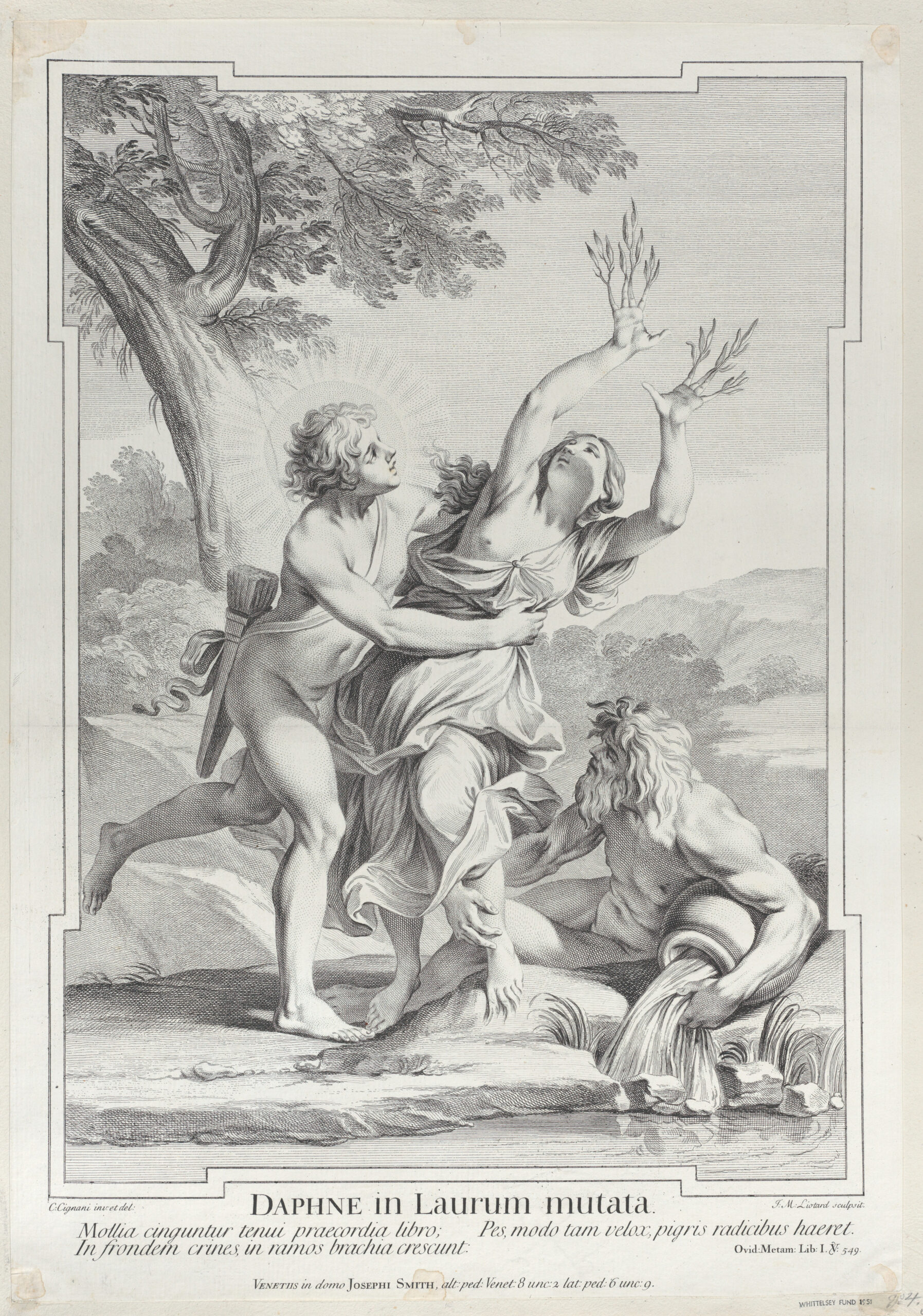
Among the many tales compiled in the 30,000+ lines of John Gower’s Confessio Amantis is the story of Daphne and Phoebus (III.1681-1728). Gower may have had the story from Ovid. Over 40 lines, we are introduced to Daphne (beautiful, the refuser of Phoebus’s love), Phoebus (so besotted that he’s afflicted further by Cupid, who pierces him with golden, fiery dart (III.1696-7), and Cupid (who pierces Daphne with a dart of lead (III.1701).
And for to make him full believe
That no Folhaste mihte achieve
To gete love in such degree,
This Daphne into a lorer tre
Was torned, which is evere grene,
In tokne, as yit it mai be sene,
That sche schal duelle a maiden stille,
And Phebus failen of his wille. (III.1709-16)
[and to make him believe that rashness cannot succeed in getting love like this, Daphne was turned into a laurel tree, whose leaves are always green, to signify, as can still be seen, that she will remain a virgin [or shall live as a still maiden], and Phoebus failed in his will]
Gower ends the story here and immediately moralizes it, likely following a model he found in the massive French verse commentary of the Ovide moralisé.[1] His moral? Don’t hurry love. If your lady isn’t interested, don’t force it. Gower’s Amans acknowledges the legitimacy of this moral while questioning its relevance for his own situation: since “mi ladi is / No tre, bot halt hire oghne forme” (III.1726-27; my lady is no tree, but still has her own shape), he sees no way to leave his desire.
Gower’s version of the story is much abbreviated from what Ovid gives us. In Ovid, Phoebus cannot leave her alone: he touches the bark, embraces the tree, and yet the tree still refuses him. Phoebus insists, though, that he and Daphne, even as a laurel, will be entwined, as laurel will crown generals, and the tree always stand at the doorway of Augustus’s palace – here we must imagine that Ovid had in mind a particular tree. At this, Ovid’s laural does what Gower’s does not: she responds, as “her top seemed to shake like a head” (atque caput visa est agitasse cacumen).[2] Whether this shaking is consent or not is a question for the commentators.
For today, I’m interested in approaching Gower through our four readings, very briefly, with the expectation that you as a class will build on what I’m offering here. Again, we read works from 1935 to literally just last week: Roger Caillois’s “Mimicry and Legendary Psychasthentia,” published originally in the surrealist journal Minotaur; Yi-Fu Tuan (d. 2022), founder of “humanistic geography,” in 1968 on “Discrepancies between Environmental Attitude and Behaviour”; Sara Ritchey’s 2009 “Rethinking the Twelfth-Century Discovery of Nature,” which either anticipates or belongs to her 2014 Holy Matter, some of which we already read this semester; and finally Adam J. Goldwyn on “Did Byzantines feel ecological grief?”: Goldwyn is an associate professor of English at North Dakota State University and, not incidentally, a possessor of a 2010 degree in Comparative Literature from CUNY, right here.
Briefly, because I want you to do most of the work today:
Yi-Fu Tuan establishes a contrast immediately between the rigid lines and open sight lines of seventeenth-century European gardens and the curviness of medieval Chinese gardens, conducive to requiring the visitor to appreciate the garden as bodies in space and time, not just as viewers. Surely the latter approach represents a less anthropocentric, more decentered attitude towards the nonhuman world, if we can speak of so singly a thing! Yet, as Tuan demonstrates, Chinese gardens of this sort require enormous levels of maintenance and a massive dispersal of plants and dirt to establish. Later he observes that the Buddhist preservation of trees before their shrines are more than offset by the funeral requirement of cremation: a handful of trees saved in exchange for whole forests destroyed gradually, sacrificed to the sudden destruction of individual corpses that might have better been planted in the ground to give themselves up gradually through putrefaction.
In short: is Christianity to blame for our present ecological devastation? Is the post-Christian era inaugurated by Descartes to blame? Can we find in the Middle Ages, say, the European Middle Ages, resources to offset our own era’s catastrophe (on this, Ritchey: “In something of a neo-Romantic moralizing fashion, a few scholars have turned to investigations of what they perceive as a medieval ‘enchantment’ with nature, where a sacramental perception of the twelfth-century world holds lessons for a flailing twenty-first-century political ecology” (233))? “If the rule you followed brought you to this, of what use was the rule?”: maybe we can find some rule that would have left us better off, maybe among the tree cults of the Romans.
But what Tuan’s article would suggest is something all too often forgotten in so much of the ecocriticism I’ve encountered. With Daphne, we’ll remind ourselves that the Roman reverence for this tree or that tree was not a reverence for trees in general. Ovid’s Apollo elevates the laurel as a species, sure, but there’s only one tree he tries to, well, you can finish the sentence.[3] We can have in mind Adam Goldwyn’s observations about a rhetorical set text in Nikephoros Basilakes’ Prgoymnasmata in which Myrrha, pregnant – by her father – with Adonis, is now a tree, saved by Eros from a woodcutter’s ax. This is not because Eros loves trees in general: it is because the tree is actually a person, “given humanity” even (12). We can ask whether anthropomorphism is requisite for such extensions of protection – are we to believe that Phoebus’s love of Daphne does not transform somehow after she becomes a tree?
All I have space to do now is just to gesture at the Caillois. But I think of what he says about Dalí (whom he rescues, I think, from himself), in whose work we find “mimetic assimilations of the animate to the inanimate.” As for Daphne, I think of her slowness, her leadenness, in relation to Phoebus’s fiery passion; of her greenness, which attests to a kind of continual and therefore frozen fertility, a springtime that never ends or advances; of Daphne’s attempt to erase the distinction between foreground and background; of the fact that Daphne does not do this to herself, or anyone or anything to her, but that, in Gower, it is just something done to her; of the Daphne that we know to be present despite the transformation (hunting not by sight, but by desire!); and of this:
“It should be noted in any case that in mimetic species the phenomenon is never carried out except in a single direction: the animal mimics the plant, leaf, flower, or thorn, and dissembles or ceases to perform its functions in relation to others. Life takes a step backwards.”
Have at it!
- Recently translated into English! The whole thing! ↑
- See the discussion in Warren Ginsburg Tellers, Tales, and Translation in Chaucer’s Canterbury Tales p. 24 ff ↑
- Paul McCarthy, 1992, “The Garden.” Incidentally, for a good recent reading of the Caillois (putting aside Elizabeth Grosz’s foundational engagement 30 years ago in her Volatile Bodies, see the contribution by Nidesh Lawtoo to the 2022 issue of the journal Effects. You can find Lawtoo’s essay through various means. It’s good. For more on Grosz, see Oli Stephano. “Irreducibility and (Trans) Sexual
Difference.” Hypatia 34, no. 1 (2019): 141–54. doi:10.1111/hypa.1244 ↑
